
Rethinking Education in the Age of AI
What if AI could help us become more human?

Many people are talking about how AI will transform education. It’s hard not to be captivated by instant answers, smart tutoring, and personalized content. You can even have AI impersonate your favorite thought leader.
But what if the most radical promise of AI isn’t more information but more intelligent relation? Not just faster facts, but deeper understanding between people.
The fact is that facts never have meaning outside of context.
The great fallacy of education is that it’s possible to have neutral information.
Facts are never isolated. They live in stories shaped by who’s telling them and why.
Any situation only takes on meaning through the relationship that affected people have with it. Depending on who you talk to, you’ll get a different version of “the facts”.
After apartheid, South Africa’s Truth and Reconciliation Commission let victims and perpetrators tell their stories - not to erase pain, but to build relational context.
The same underlying dynamics exist in today’s most polarizing conflicts: USA and China, Russia and Ukraine, Israel and Palestine. Each side holds a radically different narrative. What’s often missing is the ability, or willingness, to understand how the other side is making sense of their world.
This isn’t about agreeing with every perspective. It’s about understanding how meaning is being made.
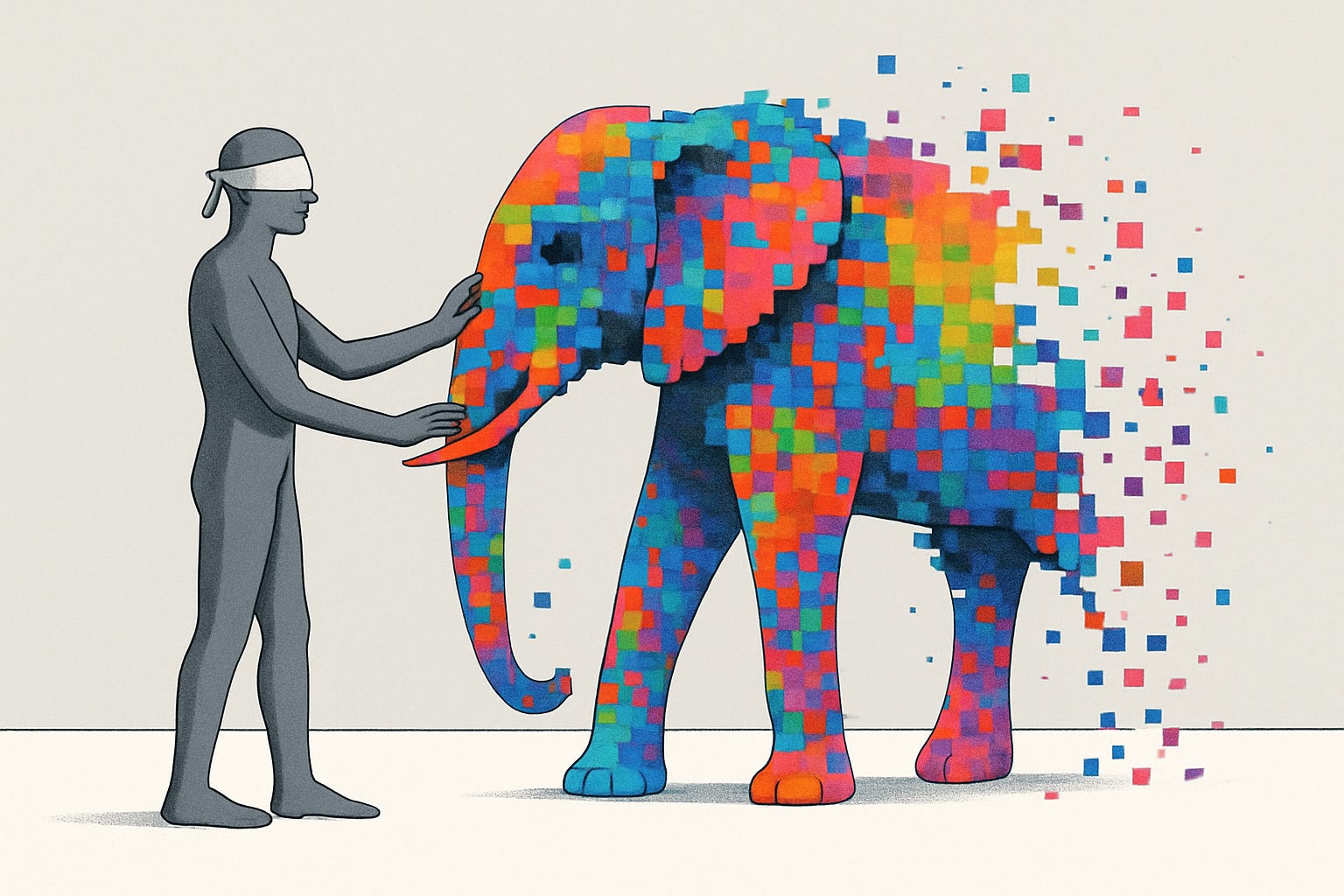
There’s a famous parable about a group of blind men who encounter an elephant. One touches the trunk and says it’s a rope. Another feels the side and says it’s a wall. Another touches a leg and says it’s a tree. Each insists they’re right. And they are - within their limited context.
Meaning is always contextually derived.
Which has profound implications for how we learn.
If meaning arises from context, then education must help us develop contextual awareness - a capacity that’s rarely cultivated in traditional systems.
One of the simplest ways to cultivate contextual awareness is by explicitly acknowledging that information only takes on meaning within context - and then exploring that and other possible contexts, together.
But context is more than just more information. It’s about the lived experience of another person. It’s inherently relational.
And this is where AI has surprising potential and power.
Because one of AI’s most valuable functions is facilitating conversation.
Conversation is at the heart of transformational education.
Traditional learning moves in one direction: from teacher to student. It offers a single version of the truth, often stripped of nuance and complexity.
Conversational learning, on the other hand, invites many voices. It surfaces diverse perspectives and lived experience. It honors relationship. And in doing so, it cultivates contextual awareness.
Now, for the first time, AI offers the capacity to facilitate group interaction at scale, asynchronously and on demand.
Some fear AI will cause people to lose touch with each other as they bond with machines. But what if AI can help us have better relationships with each other?
What if AI can mediate and support group exchanges in a way that cultivates relational intelligence and mutual understanding?
This isn’t just hypothetical.
At Sutra, we’ve been working with AI to power asynchronous conversational learning experiences. People participate on their own time. The AI engine surfaces the most thoughtful contributions and weaves connections between what people share.
The results? Deeper engagement. More coherence. And some of the most meaningful online dialogues I’ve ever participated in.
The AI engine analyzes participant conversation to surface things like sentiment, bias and blindspots, perspective diversity, and common themes. This data makes visible dimensions of a group’s engagement that are often below the surface and unseen.
In this model, learners don’t just consume information. They participate in creating shared understanding. Learning is no longer a one way street.
This isn’t just a new format. It’s a new paradigm.
One that sees learning as a dynamic interplay between content, context, and conversation - where insight arises from being in relationship.
And one that delivers the very thing we’ll need most in the age of AI super intelligence: relational intelligence.